I'm not sure how I feel about this AMD / ATI merger. I definately agree and have even stated in a previous blog entry that it would be great to see the ability to add a GPU to a motherboard the same way a CPU is socketed, and with AMD's modular chip architecture this will become a reality. However, I don't believe it is necessary for AMD to own a graphics chip company in order to carry this out. I believe that Nvidia and ATI would support AMD's endeavors in the coming years and develop expansion cards that work directly with the CPU. By purchasing ATI, AMD is potentially alienating NVidia and Intel, restricting graphic chip sales and limiting competition in the graphics market for both Intel and AMD. Besides, NVidia has been developing incredible chipsets and graphics solutions for AMD systems, and it would be a shame to see that disappear or to see AMD cripple due to competition from NVidia. This deal is still pending approval from ATI's board, and although this is a great deal for ATI shareholders, I'd almost like to bank on the deal falling through. Although I support ATI as much as NVidia, I don't believe purchasing ATI is in the best interests of AMD.
Update: Check out the Anandtech article concerning this merger.
Saturday, July 22, 2006
I have a couple of things I'd like to cover with this post. First of all, I feel it is necessary to cover Intel's latest chip architecture, because I honestly am impressed and glad that Intel has finally decided to port the Pentium M architecture to desktop and server chips. I also have a few things to say about the Net Neutrality debate. I hope I don't spend too much time with these topics because I'd really like to run to Copps and pick up a few things for lunch goods and dinner tonight.
Conroe is essentially an expansion of the Pentium M architecture; it consists of a 14-stage pipeline (the Athlon64 uses 12) with 4 instruction decode units, 3 integer units, and 3 (2 concurrently-operational) 128-bit SSE units (compared to 2 64-bit SSE units in the Athlon64).
Ultimately, I am just glad to see further advancements in computer architecture and more competition; in fact, it looks like the Athlon64 5000+ should be under $300 in the near future due to the Core 2 Duo. Memory bandwidth constraints has been a limiting factor in microprocessor systems for at least the past 5 years, and the approaches taken by AMD and now Intel allows to better utilization of the resources available. The on-chip memory controller utilized in the Athlon64 and the prefetching, load forwarding and out-of-order execution techniques, and the larger caches present in the Conroe-based processors demonstrate the acknowledgement of better memory utilization in modern microprocessors. It also allows for more efficient use of the hardware, as demonstrated by lower power consumption in both the Intel and AMD CPUs. Ultimately, the Pentium M team chose the right approach by creating a more efficient microprocessor design for power consumption, and likewise for the Athlon team in terms of staying competitive.
AMD has had such a large influence on Intel; competition is great! The Netburst architecture died away and a more natural upgrade to 64-bit was adopted. In addition, NVidia has become a significant force in chipset development; SLI has become incredibly popular and NVidia continues to make an excellent chipset for AMD and Intel systems.
Alright, that ramble lasted a bit longer than I anticipated...
Now, Net Neutrality... I currently view the internet as an equal opportunity and free market. Anyone can create content that can attract lots of attention, or start a unique business that can generate a lot of revenue. It has definately diversified the marketplace, and has allowed people to voice their opinions to the entire world. Video and voice services have become more popular with the emergence of broadband connections to homes, and the transmission line business has expanded to coaxial and wireless. Of course, companies like AT&T would like a cut of the revenue as Internet media transmission expands; they have become obsolete for phone service and cannot effectively compete with IPTV without dedicated bandwidth for their services. According to Ted Stevens, what these transmission companies really want to do is charge a delivery fee to companies, similar to FedEx and UPS, which is bullshit. In addition, any kind of prioritization on the internet would employ a more capitalistic market, changing the internet from a free market to an industry that would require a company to have large amounts of capital to start a business; essentially created a new tv or movie industry.
However, I also believe that Quality of Service may be an important issue in terms of transmission of data over the internet. Video and voice services require a certain amount of bandwidth and a lower amount of latency to stream effectively over the internet. Quality of Service should be a standard incorporated in the Internet, so that voice, video, and gaming packets, for example, receive enough priority in the transmission of bits for proper streaming. Rather than trying to create a market and rely on monetary discrimination, upgrade the service / infrastructure and charge more to companies and/or consumers, if need-be. I would rather see the Internet improve and remain open but potentially pay a little bit more for the connection than run into another instance where alternative methods are seeked to reduce the immediate costs to the consumers but impose "delivery fees" for content and services in the future.
If anybody ends up reading this and has an opinion on Net Neutrality, please express it below, as I would like to have a good discussion concerning it.
Conroe is essentially an expansion of the Pentium M architecture; it consists of a 14-stage pipeline (the Athlon64 uses 12) with 4 instruction decode units, 3 integer units, and 3 (2 concurrently-operational) 128-bit SSE units (compared to 2 64-bit SSE units in the Athlon64).
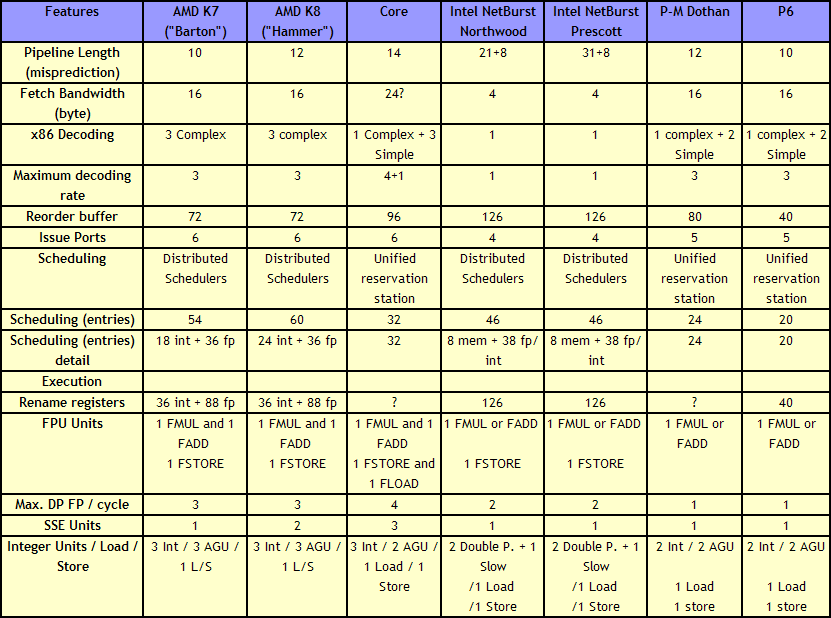
Ultimately, I am just glad to see further advancements in computer architecture and more competition; in fact, it looks like the Athlon64 5000+ should be under $300 in the near future due to the Core 2 Duo. Memory bandwidth constraints has been a limiting factor in microprocessor systems for at least the past 5 years, and the approaches taken by AMD and now Intel allows to better utilization of the resources available. The on-chip memory controller utilized in the Athlon64 and the prefetching, load forwarding and out-of-order execution techniques, and the larger caches present in the Conroe-based processors demonstrate the acknowledgement of better memory utilization in modern microprocessors. It also allows for more efficient use of the hardware, as demonstrated by lower power consumption in both the Intel and AMD CPUs. Ultimately, the Pentium M team chose the right approach by creating a more efficient microprocessor design for power consumption, and likewise for the Athlon team in terms of staying competitive.
AMD has had such a large influence on Intel; competition is great! The Netburst architecture died away and a more natural upgrade to 64-bit was adopted. In addition, NVidia has become a significant force in chipset development; SLI has become incredibly popular and NVidia continues to make an excellent chipset for AMD and Intel systems.
Alright, that ramble lasted a bit longer than I anticipated...
Now, Net Neutrality... I currently view the internet as an equal opportunity and free market. Anyone can create content that can attract lots of attention, or start a unique business that can generate a lot of revenue. It has definately diversified the marketplace, and has allowed people to voice their opinions to the entire world. Video and voice services have become more popular with the emergence of broadband connections to homes, and the transmission line business has expanded to coaxial and wireless. Of course, companies like AT&T would like a cut of the revenue as Internet media transmission expands; they have become obsolete for phone service and cannot effectively compete with IPTV without dedicated bandwidth for their services. According to Ted Stevens, what these transmission companies really want to do is charge a delivery fee to companies, similar to FedEx and UPS, which is bullshit. In addition, any kind of prioritization on the internet would employ a more capitalistic market, changing the internet from a free market to an industry that would require a company to have large amounts of capital to start a business; essentially created a new tv or movie industry.
However, I also believe that Quality of Service may be an important issue in terms of transmission of data over the internet. Video and voice services require a certain amount of bandwidth and a lower amount of latency to stream effectively over the internet. Quality of Service should be a standard incorporated in the Internet, so that voice, video, and gaming packets, for example, receive enough priority in the transmission of bits for proper streaming. Rather than trying to create a market and rely on monetary discrimination, upgrade the service / infrastructure and charge more to companies and/or consumers, if need-be. I would rather see the Internet improve and remain open but potentially pay a little bit more for the connection than run into another instance where alternative methods are seeked to reduce the immediate costs to the consumers but impose "delivery fees" for content and services in the future.
If anybody ends up reading this and has an opinion on Net Neutrality, please express it below, as I would like to have a good discussion concerning it.
Thursday, July 13, 2006


Sunday, July 09, 2006
Alright, it's time for me to ramble about how fuckin' scared I am over this AT&T bullshit. When I heard that SBC and AT&T were merging last year, I was in awe, but I still had a little bit of faith with our Justice Department. The baby bells were becoming one once again, and nobody was stopping them. Granted, the power the telephone industry once had has dwindled, but that does not justify the reconstitution of an entity generating hundreds of billions of dollars a year. To make matters worse, AT&T has recently announced that they would like to acquire Bellsouth, created a duolopy between Verizon and AT&T, and in turn Cingular. $130 billion dollars in revenue per year...and we thought the oil industry was ridiculous. Here's a breakdown of the Baby Bell monopoly. I hope this judge gets his say.
Subscribe to:
Comments (Atom)