Technology analysis of the latest gadgets, consoles, and computer architectures.

Tuesday, October 05, 2004

Open Source - How Should It Shape the Computer Industry

A big topic in the computing world lately has to do with open source licensing. What should be open sourced, and what should remain copyrighted? The BSD license is different from the GPL in that it allows source code to be used in a commercial product; this seems reasonable because otherwise the entire software industry will move towards services. We're seeing that already with Red Hat, IBM, and other Linux-based companies, but we're also seeing companies like Sun and Novell who clearly make it known that proprietary technology will remain a large part of their business, and that the open source community can work with the business world to create products, not just services.

I would agree with the way the BSD license works, since it does allow for innovation beyond the base product. Bill Gates makes a point by saying that there will still be complex tasks that would be best accomplished in an open source environment (the video can be seen here). In the end, however, business will determine whether these BSD-based products will have enough contributions beyond the base product to have a value.

Jonathan Schwartz also argues in his blog that although Sun open sources some of its software (OpenOffice/StarOffice), software patents are necessary to incent "inventors to invent, and investors to invest". He does mention that there is a difference between open standards and open source, and that is where things get a little hazy. I would like to believe that open source software pushes for standards in areas where the standard is too complex to document (i.e. an operating system), and by commoditising software by creating an open source derivative of something a standard is essentially created. Open source is just a subset of open standards, so I am not implying that commercial software or support cannot be created around open source or open standards.

I guess we'll see how things pan out in the future of the software industry. We are already seeing two sides form, one based on services and the other integrating open source products in commercial goods. For the industry to remain as large as it has been these past few years, this mix is necessary.

Thursday, September 30, 2004

Dual Processor Motherboard...CPU and a Graphics Chip?

ISA, PCI, AGP, and PCI Express all have one thing in common: they are bus interfaces that allow you to extend the capability of your motherboard through add-ons such as a graphics and sound system, network connectivity, etc. We've already seen built-in sound and network systems, and basic integrated graphics. However, the graphics system is second only to the CPU in terms of power and performance, and is very relavent to the speed of the computer. The system bus is constantly improving to accomodate for the bandwidth demand of the graphics card. So why isn't such an important component an actual part of the motherboard? Just like we can choose a CPU and replace it when an upgrade is due, why can't we just pop out a graphics chip and replace it with a newer one?

I will admit that many of the newer motherboards are crowded enough as it is, but integrating the graphics chip into the motherboard, along with its own set of memory, would eliminate the bottleneck of the PCI bus (assuming the graphics chip is connected through HyperTransport or a similar technology) and make the graphics system a more regular and cost-effecient upgrade. All that would have to be replaced is the graphics chip; no board or memory to increase the cost.

Although a nice solution, there are a few negative aspects to consider.

- First of all, if the graphics chip ever changed in size, the motherboard would have to be replaced. However, if this method was ever adopted, the lifespan of the graphics architecture would be about the same as the CPU, so an upgrade should entitle some sort of processor upgrade as well.
- This option would be a limiting factor for people with older systems. AGP has been around for at least 5 years, a lot longer than a typical upgrade.
- The graphics interconnect system would be limited to the technologies present on the motherboard. On current graphics cards, the speeds between the graphics chip and the memory are typically "the latest and greatest". I believe some graphics cards use DDR2 and have a 1 GHz bus, which may be about right for current PC's, but using a graphics chip on an older motherboard would limit the graphics system.

From a technology standpoint, having the graphics chip on-board would be a more efficient solution overall. However, the positive aspects have to outweigh any negative ones, and in this case, the race is close. I guess we'll see what happens in the future, especially when Intel comes up with a solution similar to HyperTransport.

Wednesday, September 29, 2004

Looks like the online music industry is moving in the right direction...Buy.com's music store now offers a choice in bitrate. When you purchase a song, you can choose whether you want to download a 256 kbps or 128 kbps version of the song. It's WMA so 256 is as high as you can before you hit lossless. The prices are also pretty reasonable; although most songs seem to be $.99 each, it was only $7.99 for the Skindred album. Unfortunately, not all of the songs are available at 256 kbps yet, so I'll have to hold off for now. Of course, the selection is limited to mostly popular artists, so it's hard to find some independent bands. With the number of available songs increasing and bitrate approaching lossless, soon we will be closer to a viable CD replacement. Next up: offering album inserts, CD art, and 5-channel audio.

Tuesday, September 28, 2004

Hello all! I'm just blogging from Illinois. I meant to see Strike Anywhere live, but traffic prevented us from doing so. Guess it's alright...having fun at my friend Keto's place drinking and stuff. Hopefully one day I'll be able to see Strike Anywhere live again...we'll see what happens. Gotta go...later.

Sunday, September 12, 2004

Two Computers in One


At the Intel Developer Forum last week, Intel demonstrated dual-core chips incorporating the Itanium (Montecito) and the Pentium M (Napa) architecture. The Itanium system demonstrated contained 4 dual-core chips using HyperThreading, which appeared as 16 processors on the task manager in Itanium Windows (crazy, huh!). However, Itanium incorporates a new architecture that breaks away from x86, so don't expect to be using a desktop with an Itanium CPU for years to come.

I am particularly anticipating the arrival of the Pentium M dual-core chip, code-name Napa. The Pentium M architecture, designed by a team in Israel, is similar to the Athlon chips in that, instead of focusing on clock speeds, improvements to other parts of the chip are done to enhance performance. It is an excellent mobile chip that is very competitive with both Intel and AMD desktop offerings, and its lower power consumption makes it ideal in a dual-core setting.

I'm not writing this article to tout Intel's next generation of chips; AMD announced and demonstrated a dual-core chip of their own a couple of weeks ago. Since the Athlon64 architecture includes HyperTransport and the on-board memory controller, it has been designed from ground-up to support dual-core processors. I can't wait to read about all of these chips and the performance we will see out of them when they arrive sometime in 2005 (hopefully).

But there is one more remark I would like to make about Intel. Last fall, Intel announced a work-in-progress called Vanderpool. Vanderpool is a chip technology that will allow you to use one processor to run multiple operating system. With dual-core processors coming out next year, it would make sense to incorporate such a technology into these chips. Just imagine being able to run both FreeBSD and Linux (or Windows) on the same machine at the same time. With a multi-monitor and keyboard/mouse configuration, you could be playing a game on one core and watching a movie on the other without much impact on either tasks.

I can't wait for Vanderpool to be introduced into the PC market. With a technology like that, I think I might have to jump back to the Intel camp, or AMD will definately have to take advantage of their cross-license agreement, if possible. One other note I wanted to make about Vanderpool is how Intel could use it to gain market share with Itanium. Itanium has been slow to catch on due to high costs and limited software availability. Since Intel has already announced their plans for dual-core Itanium, it would be pretty cool to see a dual-core Itanium-Pentium chip. With Vanderpool, Intel will be able to vouch the ability to run native Itanium and native Pentium applications. Although both cores cannot be combined, it would be a good entry-level product to get people to start using Itanium. I guess we'll see what Intel decides to pull out of its sleeve in the coming years.

Love You Computer_Viren_Hacker_Kultur


Reverse engineering software to create computer viruses has always been looked down upon by companies and users alike, but rarely do we take a moment and look at how amazing viruses are. A convention, originally held in Frankfort, Germany in 2002, is being held this year in the U.S. and Denmark. People will be able to infect disconnected computers to watch a virus propogate and play a game to see the large scale effects of them. If anyone wants to head over to Brown University this month, I'm down...the event started September 11 and will end October 4.
100 MBits/Sec for $80/month? Why isn't this an option in Madison...

Monday, August 02, 2004

Well, I've been busy this past week, mainly with work and finishing up what I need to for my classes before my trip to Egypt/Jordan. I will be leaving tomorrow morning, and will return around August 27.

Here are some articles I meant to post links to but haven't till now:

Homeland Security protecting Bill Gates

"Big Brother Awards are now held as an annual event in 17 countries. Each event typically focuses on privacy violations in the host country.

But Privacy International opted to make an exception this year by including in the U.K. awards a U.S. initiative, US-Visit. This security program requires that most foreign visitors traveling to the United States on a visa have their index fingers digitally scanned and a digital photograph taken, so that immigration officers can verify their identity before the visitors are allowed entry into the United States."

Free Speech Zone at the Democratic National Convention is full of cameras and surrounded by barbed wire.

Monday, July 26, 2004

Articles for the Early Afternoon Time

Introducing the iPod London toilet guide - The Register

"Developed by digital media firm Nykris for reasons probably best known to themselves, pPod is a multimedia toilet guide that combines written reviews and hilariously appropriate sound tracks (Handel's Water Music, for instance) to help people find the "loveliest" facility in their vicinity.

Just what the world was waiting for."

And in other news...RealNetworks breaks Apple's hold on iPod

Months ago, RealNetworks CEO Rob Glaser attempted to meet with Steve Jobs to discuss opening up the Fairplay DRM License used with files purchased on the iTunes music store and the iPod. However, the plan was a failure when Steve made it clear that he was not interested in opening up the iPod. Apple has previously stated that the reason for the iTunes music store to exist was to sell iPods and that the music store cannot generate enough revenue on its own. Even though the Real Music Store will also help sell iPods by supporting them, Apple refuses to budge.

Looks like the tables have turned...persistence is a virtue. RealNetworks announced today that they are working on a Helix DRM-extension called Harmony. This software allows the RealNetworks Music Store AAC files to be ported to any device regardless of format, whether the device uses iTunes-based AAC Fairplay or Windows Media. In comparison to iTunes and the WMA-based music stores, RealNetworks already offers great features through its music store. In particular, I actually wouldn't mind paying $.99 a song for 192 kbit AAC files vs. 128 kbit iTunes AAC or 128 kbit WMA. I would definately start buying albums online if the songs were encoded with lossless compression (such as FLAC...might as well give LiveDownloads credit for leading the way) and, since I still like purchasing groups of songs called "albums", the album cover and insert in pdf format.

Anyways, looks like RealNetworks, in terms of services and base software and codecs, is heading in the right direction. Real Player will start to fade away in the coming years as the Real-supported Helix open-source player becomes more popular. In addition, the RealPlayer video codec remains competitive with WMV and Divx, and Helix DRM seems to be the way to go, thanks to support with multiple formats and potential porting to different operating systems and devices.

Good Luck Real!

Friday, July 23, 2004

Quick Post - Just wanted to upload my current desktop scheme for fun. My desktop background is from the Anime series Fullmetal Alchemist. The skin I'm currently using in Trillian is Microscopic Pro 2.0, with the Brushed Metal theme, and Trillian is set to change my windows to Black and White when they aren't focused. I'm currently using Taskbar Activate to hide the taskbar completely. Check it out:

Monday, July 19, 2004

Come on Baby, run Linspire...

After continuous legal battles throughout the world, Microsoft got what it wanted...Lindows has now officially become Linspire. Although Michael Robertson gave up after being very determined that Lindows was here to stay, it is probably the smartest move for the company. Partially to make the Lindows people happy, and partially to replace the original Lindows Flash animation, a new Linspire animation was created, based on The Door's "Light my Fire".

Wednesday, July 14, 2004

Just thought I'd post about the LAN party this past weekend, mainly to read some comments on how people thought it went. It took a lot out of everyone to set up all of the computers, and I have yet to finish cleaning up and return the tables to my room. I was pretty stressed out Friday night, and I hate hearing complaints from everyone; I tried, but I'm sorry I can't make everyone happy. Luckily by Saturday things went a lot more smoothly (not counting the occasional power outage). We will have to watch the appliance usage closely next time; I'll have to post signs through the apartment or something.

It would have been nice to have more time for gaming, but we had a good balance between drinking soda and sitting outside and playing games on our computers. Even though I thought the "human vs. bots" games were enjoyable for everyone, and challenging enough, I know one thing we didn't do much of was team-based Battlefield and UT. Hope you guys weren't too disappointed with that.

Anyways, I'd like to hear what you all think (even though my hunch is that they're all going to be negative comments based on the topics I outlined). If you feel that I did a crappy job "preparing", let me know what I should have done to get ready. I believe there's always going to be obstacles, but overall this apartment was the best place for the lan, and this past lan party turned out to be a lot of fun.
AT&T is setting up the powerline broadband infrastructure that could offer WiFi in our neighborhoods. By pumping 13 mbps through the power grid onto WiFi repeaters located on light posts, up to 3 mbps is offered for each trial customer. Read more here.

Monday, July 12, 2004

Are you ready to take the Google challenge? Solve an equation and you've completed the first step in the hiring process to work for Google.

Instead of just posting a "Now Hiring" sign, a Billboard found in Silicon Valley contains a URL composed of the first 10 prime digits in e. Part of the human resources function can now be completed through solving a mathematical problem floating on the web. Read more at news.com.
Josh Sutinen just sent me a link to an mp3 on the DamagedGoodz server. It's a Bud Light radio ad presenting Real Men of Genius - Mr. Company Computer Guy. "You are the guru of the gigabyte, the monster of the memory...without you, computers would megabyte...the countless hours we spend surfing the internet and accidentally stumbling upon porn sites would instead be spent working."
Here's an interesting image I thought I'd do a quick post on. I was searching for benchmarks between FreeBSD, Linux, and Windows, and found an arabic forum. Although I can't read anything on the page, I found this image and laughed.

Friday, July 09, 2004

Fuck...
http://go.hotwired.com/news/politics/0,1283,64144,00.html/wn_ascii

Guess that's how I feel when the government can conclude that I'm a terrorist based on what I read. I'm glad 1984 is a novel I've finally started reading, and I totally agree that the "power of its admonitions...seems to grow, not lessen, with the passage of time."

Oh, and I just love the fact that the GOP delayed the vote 20 minutes while they convinced 10 Republicans to change their vote. Fuckin' Congressional POSERS!!!

OK, I don't usually converse like this but it was the only way to convey the same feeling :(

Sunday, July 04, 2004

Heh, guess it's been a while since my last post. I've been busy with classes, work, and setting up and playing with my new computer. Moving up from a 450 MHz Pentium III, I sure do notice a difference in performance. To paint a picture, I've gone from 100% CPU when browsing the web with Opera and an average of 5 pages open and listening to music on Winamp to 25 - 50% with an average of 10 pages open on Opera and listening to music with Milkdrop. It is really nice to be able to max out settings in Unreal Tournament 2004 at 1280 x 960 and still have smooth gameplay. In response to a great bundle deal I participated in for my motherboard and CPU, I was able to save quiet a bit and still get an amazing system. There was a slight change in my original plans, but overall I am happy with this setup. The following are the final specs for those of you who are interested:

Asus K8V SE Deluxe - This motherbaord wasn't the MSI K8N I was so excited about, but it performs well. It incorporates a VIA chipset and has the typical features of today's motherbaords, including Gigabit ethernet, support for RAID and SATA, and 6 channel audio. I had a little bit of trouble with getting the Windows XP Setup to detect my Serial ATA drive, and unfortunately I cannot say that I was successful. It would not accept any of the drivers I was throwing at it (after pressing F6 for custom "SCSI" drivers); I even attempted to alter the txtsetup.oem files for both a VIA and Promise driver set I tried, but received the same error: (Will update later with the actual error message). If anyone knows what was wrong please post a comment about it. Luckily I found out why my partition clone didn't work (I was using a temporary 30 GB hard drive until I received the new one) and everything is fine now.

Athlon 64 3200+ - I was in for a surprise when I received this CPU; the 3200+ I received was actually one of the newer ones with 512 KB of cache but a 200 MHz faster CPU. I'm not sure how much of a difference this makes, and I know that most of the enthusiasts on Anandtech would be really bothered by this, but I don't really need the bragging rights associated to 1024 KB cache and I don't plan to overclock, so I am content with a 2.2 GHz 3200+. Before I found this bundle deal, I was planning on getting a 3000+ anyways, since the only difference between the two was going to be 512 KB vs. 1024 KB cache, so I'm not much for complaining.

In terms of temperature for both the MB and CPU, here are my results based on Asus Probe 2.0:

CPU: 35 C with Cool N Quiet, ~50 C running UT2k4
MB: 40 C typical, jumps to around 45 with UT2k4

I currently have a fan on top and in the back of the case. I may have to customize the case a little because the top fan has to go through two grates.

MGE G-Box 8011 - I'm afraid I didn't end up purchasing any of the cases that I mentioned on my previous post. It took me a long time but I finally got to the point when I had finally ordered everything but the case and had to make a decision. Overall, I was very happy with it. The G-Box is a very nice looking case and very solid. I love the top USB and audio ports; unfortunately, I have to add some shielding to the audio connector because there's interference from components in the case. I didn't care too much for the power supply since I purchased my own anyways, and although I didn't want anything to flashy at first, this case did not come with any LEDs, which may have to be remedied the next time I feel like like playing with the exterior. Anyways, here is a image of the case...visit the Newegg page for more.
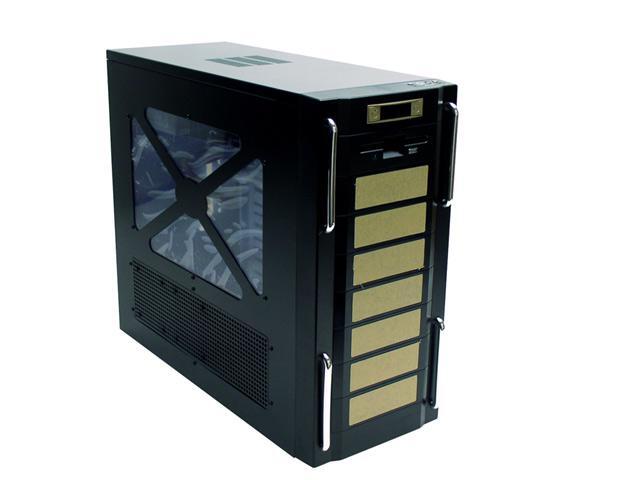


Fortron 400W FSP400-PFN Power Supply - I looked at many reviews for midrange PSUs and came to the conclusion that this was the one to look for. It is a quiet power supply that performed very well against more expensive competitors and provided enough wattage in the +3 and +5 range for AMD CPUs...more can be read at http://www.anandtech.com/showdoc.html?i=1841. The rail voltages for a PC with a 3200+, Asus mb, DVD burner and CD drive, and 9800 Pro are as follows:

+3.3 V : 3.312 V
+5 V : 4.999 V
+12 V : 11.584 V

The +12 V is a little low, but considering the devices I have plugged in I'm not holding anything against the PSU...it was a $60 power supply after all. These voltages are stable and were recorded from the Asus Probe 2.0. The only thing the +12 V rail will limit me with at this point is overclocking, which I'm not too concerned about right now. I need to concentrate on a little more cooling first.

Other Components - My 1 GB of Kingston ValueRAM seems to be doing fine. Since it is at CAS 3.0 I may have to try overclocking it a little and see how low I can take it, but I'm not too concerned. The Serial-ATA hard drive is noticably faster; even without enough reboots for XP to optimize boot time, it has started up around 5-10 seconds faster, and load time for most applications has improved, including UT. Of course, I didn't forget to mention that I am extremely happy with my ATI 9800 Pro 128 MB, and I got an excellent deal on it. I haven't yet had a chance to mess with a high performance NVidia card, and I would love to see what kind of features the driver offers, but I will have to hold off until my next upgrade.

Hmm...4 AM again. Just a few more things to copy over and install on this computer and I can finally take down my old computer for good. I have it plugged into my other monitor and I know it's just begging for attention. Maybe I'll give it one last run soon before I wipe it clean and try to make it into a media center PC for my parents.

Happy 4th all...I'll be sure to put my game on for the celebration.

Wednesday, June 23, 2004

Here's a news article worth mentioning: "Hotmail to offer 250MB of free storage"

It just makes me laugh...thanks to Google, both Yahoo and Microsoft have responded by adding significantly more space to normail mail accounts. Just imagine what things would be like without Google...inferior search engines, less innovation, incredibly small mail storage space, or in other words, less competition. Read more here.