Saturday, December 01, 2007
Browsing a Library Catalogue and Looking at Photos in an Entirely New Way
I wouldn't mind browsing a library catalogue and looking at pictures taken throughout the world this way, ultimately using multitouch technology.
Internet-based Video Application for the Mainstream
Yeah, the cellular carrier switch never happened, and I'm still use that crappy Kyocera 7135. And my mediapc is not my old PC and instead uses an AM2 platform in a SFF case (for those of you interested in the components used for this mediapc, stay tuned). However, those aren't the reasons I put together a new Tech Ramble blog post. I was actually sitting here in the Philippines on an extended business trip thinking more and more about how I hate cable TV and love internet-based distribution of traditional video content on-demand, and how Joost really does have the potential to become the next mainstream on-demand video application to replace traditional TV if the content distributors allow it to, and it really got me ready to rant...
I have been using Joost on and off for at least 6 months now; the user interface has improved drastically and the platform has allowed for a great deal of independent artists and content distributors to create channels that allow people to easily gain access to their content from a central location. The embedding of commercials between program segments also works very well, and provides for an interactive experience with the advertising companies as well.
Joost would actually be the ideal platform to allow the content distributor or artist to choose how many ads are required for their shows to allow for a variability to be applied based on viewership and costs associated to the content, etc. One program may require no or minimal ads while another would require 6-10 minutes of ads for a 20 minute program, as in traditional TV programs. I believe this would essentially ease in more traditional content distributors to give Joost a chance and provide their content for a centralized, internet-based remote-controlled user experience.
What I don't like seeing is the industry moving to their own distribution methods using either their own hosted websites or alternative sites to host multi-network content online, and here's why. I own a Macbook Pro, and prior to my upgrade to Leopard (stay tuned for more), the latest version of Joost supported my Macbook Pro remote (yay!). That meant that once I started the application, I was able to sit back and use the remote to browse the menus and select programs to watch, all hosted off of the internet.
This is how I expect future TV to work. I don't want to be required to use a mouse and keyboard to point my browser to a different website and use a less-mature flash-based html video application to watch my favorite shows (sorry nbc.com, comedycentral.com, southparkstudios.com, abc.com, fox.com, hulu.com, etc, etc). Viacom started to take the right step when Joost was first introduced by allowing some of their content to appear on the service (noteably missing The Daily Show and South Park), but lately the content is unplayable on Joost. I know that Joost has been actively trying to negotiate terms with all content distributors, and that's where this article comes in.
If Joost developers and management are reading this, please consider adding more flexibility in ad time based on what the content providers want, provide more flexibility on the types of ads shown to make this transition easier and quicker for traditional TV providers (including the option to upload ads, if revenue sharing can be managed), and allow for a monthly subscription model per channel for a reasonable cost (to bring in more cable content).
Traditional TV content providers, please don't slow down internet-based TV. It is the future of content distribution, and although adding any content online is a great first step, not using a well-designed video application like Joost and *gasp* Youtube prevents users from enjoying the experience of watching TV shows online with the same couch-potato-emphasis that traditional TV (and Tivo-like devices) provide. As someone in This Week in Tech (either episode 121 or 122) pointed out, when people think of using a computer they think of leaning, and people don't want to lean to watch TV; they want to sit or lay back and watch TV. Lets avoid mouse and keyboard usage for watching TV as much as possible, for the sake of watching TV on a computer, as I do here all the time.
More on my mediapc and Leopard later...
I have been using Joost on and off for at least 6 months now; the user interface has improved drastically and the platform has allowed for a great deal of independent artists and content distributors to create channels that allow people to easily gain access to their content from a central location. The embedding of commercials between program segments also works very well, and provides for an interactive experience with the advertising companies as well.
Joost would actually be the ideal platform to allow the content distributor or artist to choose how many ads are required for their shows to allow for a variability to be applied based on viewership and costs associated to the content, etc. One program may require no or minimal ads while another would require 6-10 minutes of ads for a 20 minute program, as in traditional TV programs. I believe this would essentially ease in more traditional content distributors to give Joost a chance and provide their content for a centralized, internet-based remote-controlled user experience.
What I don't like seeing is the industry moving to their own distribution methods using either their own hosted websites or alternative sites to host multi-network content online, and here's why. I own a Macbook Pro, and prior to my upgrade to Leopard (stay tuned for more), the latest version of Joost supported my Macbook Pro remote (yay!). That meant that once I started the application, I was able to sit back and use the remote to browse the menus and select programs to watch, all hosted off of the internet.
This is how I expect future TV to work. I don't want to be required to use a mouse and keyboard to point my browser to a different website and use a less-mature flash-based html video application to watch my favorite shows (sorry nbc.com, comedycentral.com, southparkstudios.com, abc.com, fox.com, hulu.com, etc, etc). Viacom started to take the right step when Joost was first introduced by allowing some of their content to appear on the service (noteably missing The Daily Show and South Park), but lately the content is unplayable on Joost. I know that Joost has been actively trying to negotiate terms with all content distributors, and that's where this article comes in.
If Joost developers and management are reading this, please consider adding more flexibility in ad time based on what the content providers want, provide more flexibility on the types of ads shown to make this transition easier and quicker for traditional TV providers (including the option to upload ads, if revenue sharing can be managed), and allow for a monthly subscription model per channel for a reasonable cost (to bring in more cable content).
Traditional TV content providers, please don't slow down internet-based TV. It is the future of content distribution, and although adding any content online is a great first step, not using a well-designed video application like Joost and *gasp* Youtube prevents users from enjoying the experience of watching TV shows online with the same couch-potato-emphasis that traditional TV (and Tivo-like devices) provide. As someone in This Week in Tech (either episode 121 or 122) pointed out, when people think of using a computer they think of leaning, and people don't want to lean to watch TV; they want to sit or lay back and watch TV. Lets avoid mouse and keyboard usage for watching TV as much as possible, for the sake of watching TV on a computer, as I do here all the time.
More on my mediapc and Leopard later...
Wednesday, March 07, 2007
Heavenly Sword looks really sweet!
I found it! Heavenly Sword was the game they promo'd on Heroes, and since I'm a big fan of Prince of Persia and now God of War, I have to say that this game looks sweet. Check it out:
Now I officially have one reason to buy a Playstation 3.
Now I officially have one reason to buy a Playstation 3.
Wednesday, February 28, 2007
Me Likey iPhone
iPhone...the phone that will make me switch providers. I can't help it, even if Cingular service is crappy in Wisconsin. Why, you ask? Because the Apple iPhone has become the perfect PDA/Phone I've always wanted. It plays music, videos, it has a beautiful color touchscreen, it has WiFi, it comes with a 4-8GB flash drive, and it's a phone...assuming it will be easy to install additional apps, I will be very pleased with this device. Extremely pleased. Here's a picture of the iPhone, for those of you who've been deprived of news for the past few months:

Monday, January 08, 2007

I somewhat enjoyed reading this article at InformationWeek.com comparing Mac OS X with Vista. I think that the final statement from this article places Microsoft and Apple to terms in the way products have always been developed at these companies from the get-go:
"Vista reeks of committee and design by massive consensus, while OS X shines from an intense focus on doing things in a simple, clear fashion and design for the user, not the programmer."
"Vista reeks of committee and design by massive consensus, while OS X shines from an intense focus on doing things in a simple, clear fashion and design for the user, not the programmer."
Tuesday, November 28, 2006
iTALK . Apple Cell Phone Spec Commercial
| Sweet fake ad leading to the iPhone...I really hope Apple goes through with this concept. I'm really excited, might even switch providers, if the iPhone ends up incorporating a click wheel, and really nice interface, and bluetooth. | |
Thursday, November 09, 2006
I have I few things I'd like to ramble about in this post, but I'm also kinda lazy, having returned from another long day at work and enjoying a beer, so we'll see.
First, I'd like to cover Microsoft a little bit based on current events. Windows Vista is poised for release by the end of January. I have tried the operating system in beta form about a year ago and, although I did find that the focus on security and a complete rehaul of the network stack would be reason enough to switch (I hate Windows networking in its current form, so slow...), I was not happy with how much more bloated Windows had become (I believe it was using close to 512MB RAM at boot-up) and with further changes of the graphical interface and control structure I did not want to deal with frustrations as a results of finding settings I wanted to change. With more recent developments that I am about to list, I am highly unlikely to upgrade.
1. Vista Home Basic, a crippled version of Vista with no Aero enhanced graphical interface, will come standard with new PCs and even cost more than XP for OEMs.
2. Vista Ultimate, the version of Windows anyone would want to have if they had to upgrade to XP, is projected to cost $450...why would I ever pay $450 for Windows?!?!
3. The educational license isn't going to be as flexible as in the past, potentially requiring servers functioning essentially as license servers.
4. The 64-bit version will only allow Signed Applications and Drivers to run, which means Microsoft has to approve any software package that is allowed to run on Windows.
I will admit that I would love to run a stable and reliable 64-bit operating system, but after my experience with XP-64 (the operating system used more RAM than the 32-bit version, thus bringing out a bad memory management and process scheduling system, and many of the drivers I needed I didn't have access to) and Vista Beta 2 64-bit (which did not successfully install on my PC, after I tried for many hours to get it to work), I think I'll stick with linux and OS X for 64-bit.
Other Microsoft developments I need to rant about:
1. Although I like the color choice of brown with the Zune, why the hell did they have to drop support for Plays for Sure? It doesn't make any sense to create a whole new proprietary media marketplace. And yes, I like the sharing feature, but honestly, I would rather have limited access to another's music library only when in range rather than have a copy on my device that would render itself useless after 3 listens or 3 days, but I guess I've always been an advocate for streaming services vs. subscription download services (why waste your own hard drive space on media files that will expire if you unsubscribe from the service?).
2. This deal with Novell is weird. Although Novell has been working with Windows for a long time, recently there have been many disputes between the two companies...they suffered a lawsuit phase, Novell bought Suse and started pushing for Linux, etc. And this deal has made people worry about what Microsoft might do against the open source community, since this deal exemplifies Novell from any patent disputes. Here is a good article explaining why Microsoft would probably not go after the open source / Linux community. And here is an article poking fun on a time in the future when Windows becomes open source.
Alright, enough about Microsoft. Since Intel's been getting so much attention lately, and my next computer (soon to arrive) will include the Core 2 Duo (more later), and since I've always had a great deal of interest in Nvidia in the chipset market, I'm going to briefly cover their latest chipset, the 680i. Anandtech does a great job covering this chip, but I wanted to quickly summarize it and bring up points that really excite me. First of all, Nvidia has finally created a 3rd party chipset that can compete with and, in some cases, perform better than an Intel chipset. This is a noteworthy feat, as Nvidia can now remain in enthusiasts' hearts for both camps, as both AMD and Intel continue to out-do one another in the performance championships. This is almost a role reversal for Nvidia, for as being a graphics chip maker that regularly jumps back and forth with ATI in regards to performance, now they can sit back and take advantage of the CPU market.
One of the coolest features Nvidia added to their chipset was the firewall; although I was never able to play around with it, it seemed to have a lot of potential, especially compared to other software-based solutions. They do expand these networking features in the new chipset, which is really exciting. Some of the most interesting features in this new chipset include:
1. FirstPacket - "FirstPacket is a packet prioritization technology that allows latency-sensitive applications and games to effectively share the upstream bandwidth of their broadband connection." This greatly expands the functionality of the use of one's machine as a router; not only can a firewall be utilized, but FirstPacket will allow low latency for the applications that need it, a plus especially in environments where multiple people are using computers over the same internet conncetion and gobble up all the upstream bandwidth, making it impossible for anyone on that same connection to do anything (believe me, I've had experience with it).
2. DualNet and Teaming - These features pertain to the addition of a second gigabit ethernet port, which, through the use of teaming, can function as a 2 gigabit connection to the network. Yes, I know it's not likely one will fully utilize the capabilities of this chipset, unless...
3. TCP/IP Acceleration - hardware acceleration of more networking stuff, self-explanatory, but also very cool for a heavily utilized machine on the network...hmm, there must be another name for this, just not coming to mind...
4. RAID-5 - yes, you read that right, RAID-5 support. So sweet...now one would be able to setup a reliable "backup" solution as well, for providing media to other computers on a network...dammit, i'm so close
Oh, I've got it now...this would function as a great SERVER!!! Yes, that's right, with the addition of these network accelerator functions as well as RAID-5 and using a dual or quad core CPU and with enough RAM, one could easily setup a machine that can do it all. All I would need to get is a gigabit switch and I can allow this computer to function as a router, serve files, play and serve games.
As you can see, I definately think Nvidia is still the way to go in regards to chipsets, and I can't wait until Nvidia releases this chipset for AM2 as well.
Let's see here...I do want to talk about AMD's forthcoming quad-core CPUs, to be released mid next year, and which will be compatible with AM2 (thus my interest in getting a cheap AM2 dual core processor in the near future and upgrading later on, although now I'd have to wait for the 680a), but I will just provide a link to this Extremetech article until Anandtech comes out with a review of the processor in the coming months. It's more exciting to see with some benchmarks, anyhow, so we'll just have to wait and see.
Lastly, I did want to mention that, yes you guessed it, I bought a Macbook Pro with a Core 2 Duo. I received the 0% interest credit card that I applied for and thought that a laptop would be appropriate, and still had access to the educational license, so I figured why not. It'd be useful for when I went home or even at work, considering it would be really easy to pull up a console and ssh into a server. To be honest, I'm not sure how I feel about using Mac OS again. My first computer was a Mac LC2 with OS6 or 7 (I forget, but I hated it, just didn't feel like I could do much). Now that the operating system is based on Unix, I've been itching to try it, but it still has that old mac look, with the menu bar permanentally fixed at the top of the screen (that's probably going to be the first thing I try to get rid of). And my most powerful computer will be Intel for once, and I'll probably want to use it often since it will have 2GB RAM and will be dual-core, but we'll see. I just can't wait to play with it, honestly, but I am afraid. Ah well, it's time for change...I've been sick of Windows since, well, forever, and I haven't had the nerve to use Linux as my main operating system, but now I will be able to play around with Unix and either use Windows on my main computer or finally switch to Linux; either way I'll have a functional computer, which is good.
Alright, one more thing: when it becomes time to upgrade to AM2 or whatever my new desktop system will be based on, I plan to reuse my current PC (the one that gave me a reason to start this blog) as a powerful mediapc. I'm going to convert it into a SFF (Small Form Factor) machine using the Biostar iDEQ 210P (read review here). I just like the idea of taking the CPU, graphics card, and memory from my current PC and plopping it into this new case and motherboard, and along with an HDTV card in the PCI slot, I'd be set for the living room. I'm really excited about the prospects of my computing environment this next year...my plans are to get an LCD TV and put together my new mediapc (aka old computer) and buy a new uber computer that will do anything I want. I'm so excited...which means the Tech Ramble isn't going anywhere...I'm even thinking about moving it to Digg or something so that I can start hearing more voices and less.
OK, I'm done...later dudes.
First, I'd like to cover Microsoft a little bit based on current events. Windows Vista is poised for release by the end of January. I have tried the operating system in beta form about a year ago and, although I did find that the focus on security and a complete rehaul of the network stack would be reason enough to switch (I hate Windows networking in its current form, so slow...), I was not happy with how much more bloated Windows had become (I believe it was using close to 512MB RAM at boot-up) and with further changes of the graphical interface and control structure I did not want to deal with frustrations as a results of finding settings I wanted to change. With more recent developments that I am about to list, I am highly unlikely to upgrade.
1. Vista Home Basic, a crippled version of Vista with no Aero enhanced graphical interface, will come standard with new PCs and even cost more than XP for OEMs.
2. Vista Ultimate, the version of Windows anyone would want to have if they had to upgrade to XP, is projected to cost $450...why would I ever pay $450 for Windows?!?!
3. The educational license isn't going to be as flexible as in the past, potentially requiring servers functioning essentially as license servers.
4. The 64-bit version will only allow Signed Applications and Drivers to run, which means Microsoft has to approve any software package that is allowed to run on Windows.
I will admit that I would love to run a stable and reliable 64-bit operating system, but after my experience with XP-64 (the operating system used more RAM than the 32-bit version, thus bringing out a bad memory management and process scheduling system, and many of the drivers I needed I didn't have access to) and Vista Beta 2 64-bit (which did not successfully install on my PC, after I tried for many hours to get it to work), I think I'll stick with linux and OS X for 64-bit.
Other Microsoft developments I need to rant about:
1. Although I like the color choice of brown with the Zune, why the hell did they have to drop support for Plays for Sure? It doesn't make any sense to create a whole new proprietary media marketplace. And yes, I like the sharing feature, but honestly, I would rather have limited access to another's music library only when in range rather than have a copy on my device that would render itself useless after 3 listens or 3 days, but I guess I've always been an advocate for streaming services vs. subscription download services (why waste your own hard drive space on media files that will expire if you unsubscribe from the service?).
2. This deal with Novell is weird. Although Novell has been working with Windows for a long time, recently there have been many disputes between the two companies...they suffered a lawsuit phase, Novell bought Suse and started pushing for Linux, etc. And this deal has made people worry about what Microsoft might do against the open source community, since this deal exemplifies Novell from any patent disputes. Here is a good article explaining why Microsoft would probably not go after the open source / Linux community. And here is an article poking fun on a time in the future when Windows becomes open source.
Alright, enough about Microsoft. Since Intel's been getting so much attention lately, and my next computer (soon to arrive) will include the Core 2 Duo (more later), and since I've always had a great deal of interest in Nvidia in the chipset market, I'm going to briefly cover their latest chipset, the 680i. Anandtech does a great job covering this chip, but I wanted to quickly summarize it and bring up points that really excite me. First of all, Nvidia has finally created a 3rd party chipset that can compete with and, in some cases, perform better than an Intel chipset. This is a noteworthy feat, as Nvidia can now remain in enthusiasts' hearts for both camps, as both AMD and Intel continue to out-do one another in the performance championships. This is almost a role reversal for Nvidia, for as being a graphics chip maker that regularly jumps back and forth with ATI in regards to performance, now they can sit back and take advantage of the CPU market.
One of the coolest features Nvidia added to their chipset was the firewall; although I was never able to play around with it, it seemed to have a lot of potential, especially compared to other software-based solutions. They do expand these networking features in the new chipset, which is really exciting. Some of the most interesting features in this new chipset include:
1. FirstPacket - "FirstPacket is a packet prioritization technology that allows latency-sensitive applications and games to effectively share the upstream bandwidth of their broadband connection." This greatly expands the functionality of the use of one's machine as a router; not only can a firewall be utilized, but FirstPacket will allow low latency for the applications that need it, a plus especially in environments where multiple people are using computers over the same internet conncetion and gobble up all the upstream bandwidth, making it impossible for anyone on that same connection to do anything (believe me, I've had experience with it).
2. DualNet and Teaming - These features pertain to the addition of a second gigabit ethernet port, which, through the use of teaming, can function as a 2 gigabit connection to the network. Yes, I know it's not likely one will fully utilize the capabilities of this chipset, unless...
3. TCP/IP Acceleration - hardware acceleration of more networking stuff, self-explanatory, but also very cool for a heavily utilized machine on the network...hmm, there must be another name for this, just not coming to mind...
4. RAID-5 - yes, you read that right, RAID-5 support. So sweet...now one would be able to setup a reliable "backup" solution as well, for providing media to other computers on a network...dammit, i'm so close
Oh, I've got it now...this would function as a great SERVER!!! Yes, that's right, with the addition of these network accelerator functions as well as RAID-5 and using a dual or quad core CPU and with enough RAM, one could easily setup a machine that can do it all. All I would need to get is a gigabit switch and I can allow this computer to function as a router, serve files, play and serve games.
As you can see, I definately think Nvidia is still the way to go in regards to chipsets, and I can't wait until Nvidia releases this chipset for AM2 as well.
Let's see here...I do want to talk about AMD's forthcoming quad-core CPUs, to be released mid next year, and which will be compatible with AM2 (thus my interest in getting a cheap AM2 dual core processor in the near future and upgrading later on, although now I'd have to wait for the 680a), but I will just provide a link to this Extremetech article until Anandtech comes out with a review of the processor in the coming months. It's more exciting to see with some benchmarks, anyhow, so we'll just have to wait and see.
Lastly, I did want to mention that, yes you guessed it, I bought a Macbook Pro with a Core 2 Duo. I received the 0% interest credit card that I applied for and thought that a laptop would be appropriate, and still had access to the educational license, so I figured why not. It'd be useful for when I went home or even at work, considering it would be really easy to pull up a console and ssh into a server. To be honest, I'm not sure how I feel about using Mac OS again. My first computer was a Mac LC2 with OS6 or 7 (I forget, but I hated it, just didn't feel like I could do much). Now that the operating system is based on Unix, I've been itching to try it, but it still has that old mac look, with the menu bar permanentally fixed at the top of the screen (that's probably going to be the first thing I try to get rid of). And my most powerful computer will be Intel for once, and I'll probably want to use it often since it will have 2GB RAM and will be dual-core, but we'll see. I just can't wait to play with it, honestly, but I am afraid. Ah well, it's time for change...I've been sick of Windows since, well, forever, and I haven't had the nerve to use Linux as my main operating system, but now I will be able to play around with Unix and either use Windows on my main computer or finally switch to Linux; either way I'll have a functional computer, which is good.
Alright, one more thing: when it becomes time to upgrade to AM2 or whatever my new desktop system will be based on, I plan to reuse my current PC (the one that gave me a reason to start this blog) as a powerful mediapc. I'm going to convert it into a SFF (Small Form Factor) machine using the Biostar iDEQ 210P (read review here). I just like the idea of taking the CPU, graphics card, and memory from my current PC and plopping it into this new case and motherboard, and along with an HDTV card in the PCI slot, I'd be set for the living room. I'm really excited about the prospects of my computing environment this next year...my plans are to get an LCD TV and put together my new mediapc (aka old computer) and buy a new uber computer that will do anything I want. I'm so excited...which means the Tech Ramble isn't going anywhere...I'm even thinking about moving it to Digg or something so that I can start hearing more voices and less
OK, I'm done...later dudes.
Tuesday, October 24, 2006
I've got some good news and some bad news. The good news: Apple finally upgraded the Macbook Pro to Core 2 Duo. The bad news: I've been telling everyone that I plan to buy a Macbook Pro once they upgrade the chip to Core 2. Hmm...it's not like I don't really want one, but do I have the money to buy one? And not only that, but is it worth the extra $500 to get another gigabyte of RAM, another 128 MB of video RAM, and a ~200 MHz faster chip? I'd say probably not, but it definately is scaring to end up spending $1800 (with the educational discount) and not have a laptop that is top of the line already...hmm. HELP!!!!
Monday, October 23, 2006
OMFGIMLMAO!!! Check out the first 5 minutes of this Dell keynote at the Oracle Openworld conference. Even Intel and AMD get along in this South Park like animation segment.
Sunday, October 22, 2006
If you want to know how much impact the human race has on our planet, check out this article, Imagine Earth Without People. I found it really interesting...also, if this topic interests you, check out the 30 Days episode "Off the Grid". I highly recommend watching that episode. In fact, watch all of 30 Days....good stuff.
30 Days Episodes I highly recommend watching:
101 - Minimum Wage
105 - Off the Grid
201 - Immigration
202 - Outsourcing
Other episodes I recommend:
103 - Muslims in America
204 - New Age
206 - Jail
30 Days Episodes I highly recommend watching:
101 - Minimum Wage
105 - Off the Grid
201 - Immigration
202 - Outsourcing
Other episodes I recommend:
103 - Muslims in America
204 - New Age
206 - Jail
Sunday, October 15, 2006
Oh, I don't drink and blog. Ok, I lied...I think I've done this before, but i saw this stupid yahoo blog slogan for some wine blog telling me not to drink and blog so i had to do it. I'm drunk, and somehow I managed to log in successfully to blog so that's what i'm doing. there is no point to this blog other than to say that i'm drunk and blogging. yeah, that's right, i cna stil styupe no problem shwne when durnk and blgoging. aslfjald;ajs;fja;sfdaslfjd;asfjdasfd ai gib ie vie vjiwfjsapupuipdofjfl;jsaf;vb gf gfjgalihaha this is fucn \skfja;
\.
visit it
hahah
llsosl
'
lsdfjsa;l
lsfjd;lafjkd
cPM;P
;lkj
slkd
fucki it all
\.
visit it
hahah
llsosl
'
lsdfjsa;l
lsfjd;lafjkd
cPM;P
;lkj
slkd
fucki it all
Monday, October 02, 2006
Ah, a dream come true...it's a solar / wind powered car. I don't know if I'd like to be seen driving this particular model, but I'd love to give it a testspin. Maybe in a few years it will be possible to have a car relatively close to the Saturn I drive that can go up to 80 miles per hour and is powered by the wind and sun :) Sweet...

Sunday, September 24, 2006
Space travel is soon becoming a reality through commercial efforts by many startups, such as Virgin Galactic and SpaceX. The NASA Ames group is working to create a new space economy and tourism to encourage traveling to the International Space Station. Here is a prototype for an intragalactic space station; click on the image for a CNET article reporting about the future of space travel.


Monday, August 07, 2006
It may be time to use a Mac once again, once I can afford it. I've been meaning to play around with OS X for a while, and I'd like to buy a laptop, so the Macbook Pro may be a target machine in the near future. I have decided to wait until Apple upgrades the Macbook Pro to the Core 2 Duo, and it'd be nice to get the latest version of the operating system tacked on. I feel that Apple may be my best option for a laptop, considering the form factor seems to rival those of other manufacturers and will provide me with the ability to run Windows or Linux if I choose. The last time I had a Mac was an LPII (I think that's the model, it's above the Mac Classic)...it was my family's first PC, and at the time I really hated how much Mac OS restricted my ability to tinker with the operating system, but with the switch to Darwin Unix, I've been wanting to give it a shot. The reason for the wait for the Core 2 Duo is: a) funding and b) 64-bit OS support. I hope it will be soon though.
The other upgrade I am awaiting is for my PC. I'm looking to either adopt AMD's 4x4 platform that will be coming out soon or a dual-core AMD chip. I am sticking with AMD because it will be cheap, it runs on a matured platform, and I'll be able to upgrade to the AM3 chips in the coming years. My current PC will be "demoted" to a media PC; I'll just have to purchase an HD card for it, and an HDTV of course. I hope that despite all of the expenses I have to accomodate for my parents I will be able to make this purchases within the next 6 months, but it is hard to tell at this point.
Time to enjoy my two weeks off before I start my new job as a Software Engineer. I've sold my soul but I hope that I will remain me and still have some me-time.
Later Kids!
The other upgrade I am awaiting is for my PC. I'm looking to either adopt AMD's 4x4 platform that will be coming out soon or a dual-core AMD chip. I am sticking with AMD because it will be cheap, it runs on a matured platform, and I'll be able to upgrade to the AM3 chips in the coming years. My current PC will be "demoted" to a media PC; I'll just have to purchase an HD card for it, and an HDTV of course. I hope that despite all of the expenses I have to accomodate for my parents I will be able to make this purchases within the next 6 months, but it is hard to tell at this point.
Time to enjoy my two weeks off before I start my new job as a Software Engineer. I've sold my soul but I hope that I will remain me and still have some me-time.
Later Kids!
Monday, July 24, 2006
I'm not sure how I feel about this AMD / ATI merger. I definately agree and have even stated in a previous blog entry that it would be great to see the ability to add a GPU to a motherboard the same way a CPU is socketed, and with AMD's modular chip architecture this will become a reality. However, I don't believe it is necessary for AMD to own a graphics chip company in order to carry this out. I believe that Nvidia and ATI would support AMD's endeavors in the coming years and develop expansion cards that work directly with the CPU. By purchasing ATI, AMD is potentially alienating NVidia and Intel, restricting graphic chip sales and limiting competition in the graphics market for both Intel and AMD. Besides, NVidia has been developing incredible chipsets and graphics solutions for AMD systems, and it would be a shame to see that disappear or to see AMD cripple due to competition from NVidia. This deal is still pending approval from ATI's board, and although this is a great deal for ATI shareholders, I'd almost like to bank on the deal falling through. Although I support ATI as much as NVidia, I don't believe purchasing ATI is in the best interests of AMD.
Update: Check out the Anandtech article concerning this merger.
Update: Check out the Anandtech article concerning this merger.
Saturday, July 22, 2006
I have a couple of things I'd like to cover with this post. First of all, I feel it is necessary to cover Intel's latest chip architecture, because I honestly am impressed and glad that Intel has finally decided to port the Pentium M architecture to desktop and server chips. I also have a few things to say about the Net Neutrality debate. I hope I don't spend too much time with these topics because I'd really like to run to Copps and pick up a few things for lunch goods and dinner tonight.
Conroe is essentially an expansion of the Pentium M architecture; it consists of a 14-stage pipeline (the Athlon64 uses 12) with 4 instruction decode units, 3 integer units, and 3 (2 concurrently-operational) 128-bit SSE units (compared to 2 64-bit SSE units in the Athlon64).
Ultimately, I am just glad to see further advancements in computer architecture and more competition; in fact, it looks like the Athlon64 5000+ should be under $300 in the near future due to the Core 2 Duo. Memory bandwidth constraints has been a limiting factor in microprocessor systems for at least the past 5 years, and the approaches taken by AMD and now Intel allows to better utilization of the resources available. The on-chip memory controller utilized in the Athlon64 and the prefetching, load forwarding and out-of-order execution techniques, and the larger caches present in the Conroe-based processors demonstrate the acknowledgement of better memory utilization in modern microprocessors. It also allows for more efficient use of the hardware, as demonstrated by lower power consumption in both the Intel and AMD CPUs. Ultimately, the Pentium M team chose the right approach by creating a more efficient microprocessor design for power consumption, and likewise for the Athlon team in terms of staying competitive.
AMD has had such a large influence on Intel; competition is great! The Netburst architecture died away and a more natural upgrade to 64-bit was adopted. In addition, NVidia has become a significant force in chipset development; SLI has become incredibly popular and NVidia continues to make an excellent chipset for AMD and Intel systems.
Alright, that ramble lasted a bit longer than I anticipated...
Now, Net Neutrality... I currently view the internet as an equal opportunity and free market. Anyone can create content that can attract lots of attention, or start a unique business that can generate a lot of revenue. It has definately diversified the marketplace, and has allowed people to voice their opinions to the entire world. Video and voice services have become more popular with the emergence of broadband connections to homes, and the transmission line business has expanded to coaxial and wireless. Of course, companies like AT&T would like a cut of the revenue as Internet media transmission expands; they have become obsolete for phone service and cannot effectively compete with IPTV without dedicated bandwidth for their services. According to Ted Stevens, what these transmission companies really want to do is charge a delivery fee to companies, similar to FedEx and UPS, which is bullshit. In addition, any kind of prioritization on the internet would employ a more capitalistic market, changing the internet from a free market to an industry that would require a company to have large amounts of capital to start a business; essentially created a new tv or movie industry.
However, I also believe that Quality of Service may be an important issue in terms of transmission of data over the internet. Video and voice services require a certain amount of bandwidth and a lower amount of latency to stream effectively over the internet. Quality of Service should be a standard incorporated in the Internet, so that voice, video, and gaming packets, for example, receive enough priority in the transmission of bits for proper streaming. Rather than trying to create a market and rely on monetary discrimination, upgrade the service / infrastructure and charge more to companies and/or consumers, if need-be. I would rather see the Internet improve and remain open but potentially pay a little bit more for the connection than run into another instance where alternative methods are seeked to reduce the immediate costs to the consumers but impose "delivery fees" for content and services in the future.
If anybody ends up reading this and has an opinion on Net Neutrality, please express it below, as I would like to have a good discussion concerning it.
Conroe is essentially an expansion of the Pentium M architecture; it consists of a 14-stage pipeline (the Athlon64 uses 12) with 4 instruction decode units, 3 integer units, and 3 (2 concurrently-operational) 128-bit SSE units (compared to 2 64-bit SSE units in the Athlon64).
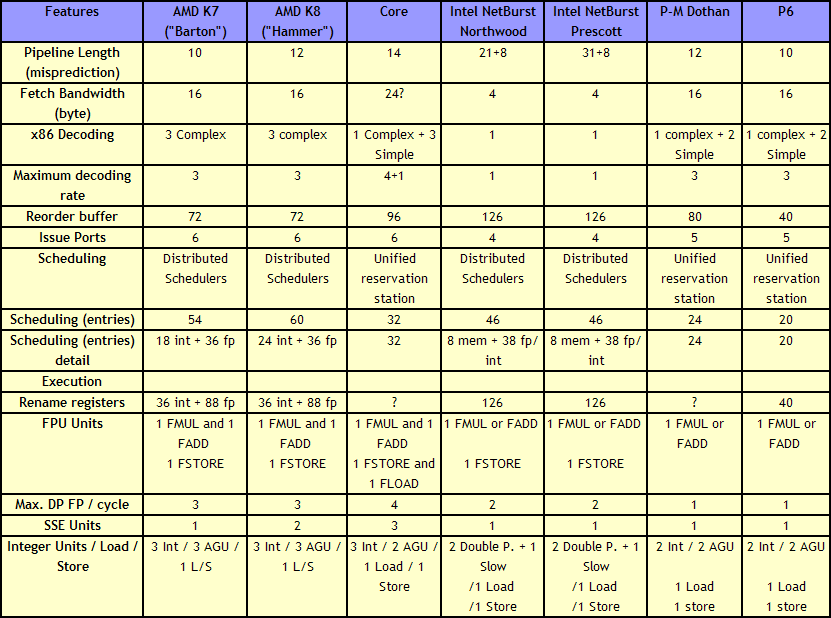
Ultimately, I am just glad to see further advancements in computer architecture and more competition; in fact, it looks like the Athlon64 5000+ should be under $300 in the near future due to the Core 2 Duo. Memory bandwidth constraints has been a limiting factor in microprocessor systems for at least the past 5 years, and the approaches taken by AMD and now Intel allows to better utilization of the resources available. The on-chip memory controller utilized in the Athlon64 and the prefetching, load forwarding and out-of-order execution techniques, and the larger caches present in the Conroe-based processors demonstrate the acknowledgement of better memory utilization in modern microprocessors. It also allows for more efficient use of the hardware, as demonstrated by lower power consumption in both the Intel and AMD CPUs. Ultimately, the Pentium M team chose the right approach by creating a more efficient microprocessor design for power consumption, and likewise for the Athlon team in terms of staying competitive.
AMD has had such a large influence on Intel; competition is great! The Netburst architecture died away and a more natural upgrade to 64-bit was adopted. In addition, NVidia has become a significant force in chipset development; SLI has become incredibly popular and NVidia continues to make an excellent chipset for AMD and Intel systems.
Alright, that ramble lasted a bit longer than I anticipated...
Now, Net Neutrality... I currently view the internet as an equal opportunity and free market. Anyone can create content that can attract lots of attention, or start a unique business that can generate a lot of revenue. It has definately diversified the marketplace, and has allowed people to voice their opinions to the entire world. Video and voice services have become more popular with the emergence of broadband connections to homes, and the transmission line business has expanded to coaxial and wireless. Of course, companies like AT&T would like a cut of the revenue as Internet media transmission expands; they have become obsolete for phone service and cannot effectively compete with IPTV without dedicated bandwidth for their services. According to Ted Stevens, what these transmission companies really want to do is charge a delivery fee to companies, similar to FedEx and UPS, which is bullshit. In addition, any kind of prioritization on the internet would employ a more capitalistic market, changing the internet from a free market to an industry that would require a company to have large amounts of capital to start a business; essentially created a new tv or movie industry.
However, I also believe that Quality of Service may be an important issue in terms of transmission of data over the internet. Video and voice services require a certain amount of bandwidth and a lower amount of latency to stream effectively over the internet. Quality of Service should be a standard incorporated in the Internet, so that voice, video, and gaming packets, for example, receive enough priority in the transmission of bits for proper streaming. Rather than trying to create a market and rely on monetary discrimination, upgrade the service / infrastructure and charge more to companies and/or consumers, if need-be. I would rather see the Internet improve and remain open but potentially pay a little bit more for the connection than run into another instance where alternative methods are seeked to reduce the immediate costs to the consumers but impose "delivery fees" for content and services in the future.
If anybody ends up reading this and has an opinion on Net Neutrality, please express it below, as I would like to have a good discussion concerning it.
Subscribe to:
Posts (Atom)