Oh, I don't drink and blog. Ok, I lied...I think I've done this before, but i saw this stupid yahoo blog slogan for some wine blog telling me not to drink and blog so i had to do it. I'm drunk, and somehow I managed to log in successfully to blog so that's what i'm doing. there is no point to this blog other than to say that i'm drunk and blogging. yeah, that's right, i cna stil styupe no problem shwne when durnk and blgoging. aslfjald;ajs;fja;sfdaslfjd;asfjdasfd ai gib ie vie vjiwfjsapupuipdofjfl;jsaf;vb gf gfjgalihaha this is fucn \skfja;
\.
visit it
hahah
llsosl
'
lsdfjsa;l
lsfjd;lafjkd
cPM;P
;lkj
slkd
fucki it all
Monday, October 02, 2006
Ah, a dream come true...it's a solar / wind powered car. I don't know if I'd like to be seen driving this particular model, but I'd love to give it a testspin. Maybe in a few years it will be possible to have a car relatively close to the Saturn I drive that can go up to 80 miles per hour and is powered by the wind and sun :) Sweet...

Sunday, September 24, 2006
Space travel is soon becoming a reality through commercial efforts by many startups, such as Virgin Galactic and SpaceX. The NASA Ames group is working to create a new space economy and tourism to encourage traveling to the International Space Station. Here is a prototype for an intragalactic space station; click on the image for a CNET article reporting about the future of space travel.


Monday, August 07, 2006
It may be time to use a Mac once again, once I can afford it. I've been meaning to play around with OS X for a while, and I'd like to buy a laptop, so the Macbook Pro may be a target machine in the near future. I have decided to wait until Apple upgrades the Macbook Pro to the Core 2 Duo, and it'd be nice to get the latest version of the operating system tacked on. I feel that Apple may be my best option for a laptop, considering the form factor seems to rival those of other manufacturers and will provide me with the ability to run Windows or Linux if I choose. The last time I had a Mac was an LPII (I think that's the model, it's above the Mac Classic)...it was my family's first PC, and at the time I really hated how much Mac OS restricted my ability to tinker with the operating system, but with the switch to Darwin Unix, I've been wanting to give it a shot. The reason for the wait for the Core 2 Duo is: a) funding and b) 64-bit OS support. I hope it will be soon though.
The other upgrade I am awaiting is for my PC. I'm looking to either adopt AMD's 4x4 platform that will be coming out soon or a dual-core AMD chip. I am sticking with AMD because it will be cheap, it runs on a matured platform, and I'll be able to upgrade to the AM3 chips in the coming years. My current PC will be "demoted" to a media PC; I'll just have to purchase an HD card for it, and an HDTV of course. I hope that despite all of the expenses I have to accomodate for my parents I will be able to make this purchases within the next 6 months, but it is hard to tell at this point.
Time to enjoy my two weeks off before I start my new job as a Software Engineer. I've sold my soul but I hope that I will remain me and still have some me-time.
Later Kids!
The other upgrade I am awaiting is for my PC. I'm looking to either adopt AMD's 4x4 platform that will be coming out soon or a dual-core AMD chip. I am sticking with AMD because it will be cheap, it runs on a matured platform, and I'll be able to upgrade to the AM3 chips in the coming years. My current PC will be "demoted" to a media PC; I'll just have to purchase an HD card for it, and an HDTV of course. I hope that despite all of the expenses I have to accomodate for my parents I will be able to make this purchases within the next 6 months, but it is hard to tell at this point.
Time to enjoy my two weeks off before I start my new job as a Software Engineer. I've sold my soul but I hope that I will remain me and still have some me-time.
Later Kids!
Monday, July 24, 2006
I'm not sure how I feel about this AMD / ATI merger. I definately agree and have even stated in a previous blog entry that it would be great to see the ability to add a GPU to a motherboard the same way a CPU is socketed, and with AMD's modular chip architecture this will become a reality. However, I don't believe it is necessary for AMD to own a graphics chip company in order to carry this out. I believe that Nvidia and ATI would support AMD's endeavors in the coming years and develop expansion cards that work directly with the CPU. By purchasing ATI, AMD is potentially alienating NVidia and Intel, restricting graphic chip sales and limiting competition in the graphics market for both Intel and AMD. Besides, NVidia has been developing incredible chipsets and graphics solutions for AMD systems, and it would be a shame to see that disappear or to see AMD cripple due to competition from NVidia. This deal is still pending approval from ATI's board, and although this is a great deal for ATI shareholders, I'd almost like to bank on the deal falling through. Although I support ATI as much as NVidia, I don't believe purchasing ATI is in the best interests of AMD.
Update: Check out the Anandtech article concerning this merger.
Update: Check out the Anandtech article concerning this merger.
Saturday, July 22, 2006
I have a couple of things I'd like to cover with this post. First of all, I feel it is necessary to cover Intel's latest chip architecture, because I honestly am impressed and glad that Intel has finally decided to port the Pentium M architecture to desktop and server chips. I also have a few things to say about the Net Neutrality debate. I hope I don't spend too much time with these topics because I'd really like to run to Copps and pick up a few things for lunch goods and dinner tonight.
Conroe is essentially an expansion of the Pentium M architecture; it consists of a 14-stage pipeline (the Athlon64 uses 12) with 4 instruction decode units, 3 integer units, and 3 (2 concurrently-operational) 128-bit SSE units (compared to 2 64-bit SSE units in the Athlon64).
Ultimately, I am just glad to see further advancements in computer architecture and more competition; in fact, it looks like the Athlon64 5000+ should be under $300 in the near future due to the Core 2 Duo. Memory bandwidth constraints has been a limiting factor in microprocessor systems for at least the past 5 years, and the approaches taken by AMD and now Intel allows to better utilization of the resources available. The on-chip memory controller utilized in the Athlon64 and the prefetching, load forwarding and out-of-order execution techniques, and the larger caches present in the Conroe-based processors demonstrate the acknowledgement of better memory utilization in modern microprocessors. It also allows for more efficient use of the hardware, as demonstrated by lower power consumption in both the Intel and AMD CPUs. Ultimately, the Pentium M team chose the right approach by creating a more efficient microprocessor design for power consumption, and likewise for the Athlon team in terms of staying competitive.
AMD has had such a large influence on Intel; competition is great! The Netburst architecture died away and a more natural upgrade to 64-bit was adopted. In addition, NVidia has become a significant force in chipset development; SLI has become incredibly popular and NVidia continues to make an excellent chipset for AMD and Intel systems.
Alright, that ramble lasted a bit longer than I anticipated...
Now, Net Neutrality... I currently view the internet as an equal opportunity and free market. Anyone can create content that can attract lots of attention, or start a unique business that can generate a lot of revenue. It has definately diversified the marketplace, and has allowed people to voice their opinions to the entire world. Video and voice services have become more popular with the emergence of broadband connections to homes, and the transmission line business has expanded to coaxial and wireless. Of course, companies like AT&T would like a cut of the revenue as Internet media transmission expands; they have become obsolete for phone service and cannot effectively compete with IPTV without dedicated bandwidth for their services. According to Ted Stevens, what these transmission companies really want to do is charge a delivery fee to companies, similar to FedEx and UPS, which is bullshit. In addition, any kind of prioritization on the internet would employ a more capitalistic market, changing the internet from a free market to an industry that would require a company to have large amounts of capital to start a business; essentially created a new tv or movie industry.
However, I also believe that Quality of Service may be an important issue in terms of transmission of data over the internet. Video and voice services require a certain amount of bandwidth and a lower amount of latency to stream effectively over the internet. Quality of Service should be a standard incorporated in the Internet, so that voice, video, and gaming packets, for example, receive enough priority in the transmission of bits for proper streaming. Rather than trying to create a market and rely on monetary discrimination, upgrade the service / infrastructure and charge more to companies and/or consumers, if need-be. I would rather see the Internet improve and remain open but potentially pay a little bit more for the connection than run into another instance where alternative methods are seeked to reduce the immediate costs to the consumers but impose "delivery fees" for content and services in the future.
If anybody ends up reading this and has an opinion on Net Neutrality, please express it below, as I would like to have a good discussion concerning it.
Conroe is essentially an expansion of the Pentium M architecture; it consists of a 14-stage pipeline (the Athlon64 uses 12) with 4 instruction decode units, 3 integer units, and 3 (2 concurrently-operational) 128-bit SSE units (compared to 2 64-bit SSE units in the Athlon64).
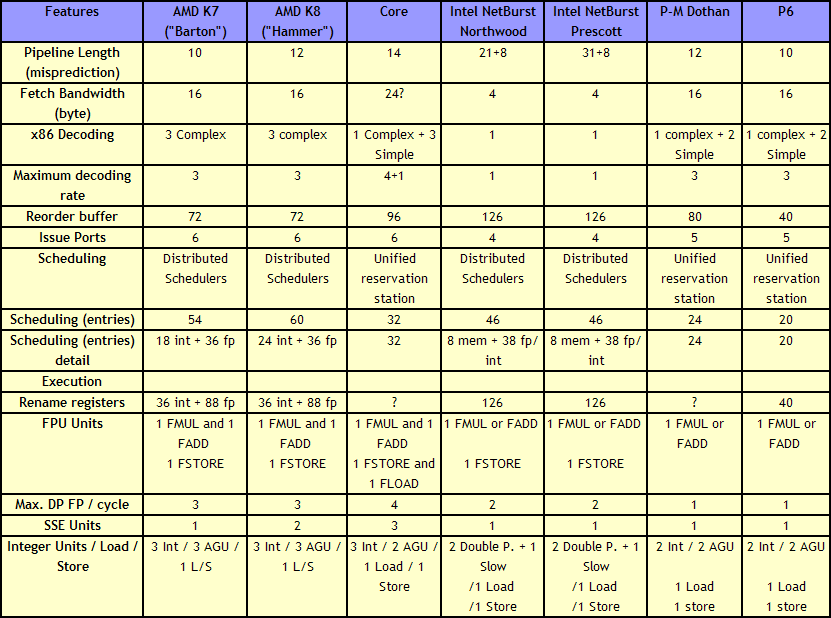
Ultimately, I am just glad to see further advancements in computer architecture and more competition; in fact, it looks like the Athlon64 5000+ should be under $300 in the near future due to the Core 2 Duo. Memory bandwidth constraints has been a limiting factor in microprocessor systems for at least the past 5 years, and the approaches taken by AMD and now Intel allows to better utilization of the resources available. The on-chip memory controller utilized in the Athlon64 and the prefetching, load forwarding and out-of-order execution techniques, and the larger caches present in the Conroe-based processors demonstrate the acknowledgement of better memory utilization in modern microprocessors. It also allows for more efficient use of the hardware, as demonstrated by lower power consumption in both the Intel and AMD CPUs. Ultimately, the Pentium M team chose the right approach by creating a more efficient microprocessor design for power consumption, and likewise for the Athlon team in terms of staying competitive.
AMD has had such a large influence on Intel; competition is great! The Netburst architecture died away and a more natural upgrade to 64-bit was adopted. In addition, NVidia has become a significant force in chipset development; SLI has become incredibly popular and NVidia continues to make an excellent chipset for AMD and Intel systems.
Alright, that ramble lasted a bit longer than I anticipated...
Now, Net Neutrality... I currently view the internet as an equal opportunity and free market. Anyone can create content that can attract lots of attention, or start a unique business that can generate a lot of revenue. It has definately diversified the marketplace, and has allowed people to voice their opinions to the entire world. Video and voice services have become more popular with the emergence of broadband connections to homes, and the transmission line business has expanded to coaxial and wireless. Of course, companies like AT&T would like a cut of the revenue as Internet media transmission expands; they have become obsolete for phone service and cannot effectively compete with IPTV without dedicated bandwidth for their services. According to Ted Stevens, what these transmission companies really want to do is charge a delivery fee to companies, similar to FedEx and UPS, which is bullshit. In addition, any kind of prioritization on the internet would employ a more capitalistic market, changing the internet from a free market to an industry that would require a company to have large amounts of capital to start a business; essentially created a new tv or movie industry.
However, I also believe that Quality of Service may be an important issue in terms of transmission of data over the internet. Video and voice services require a certain amount of bandwidth and a lower amount of latency to stream effectively over the internet. Quality of Service should be a standard incorporated in the Internet, so that voice, video, and gaming packets, for example, receive enough priority in the transmission of bits for proper streaming. Rather than trying to create a market and rely on monetary discrimination, upgrade the service / infrastructure and charge more to companies and/or consumers, if need-be. I would rather see the Internet improve and remain open but potentially pay a little bit more for the connection than run into another instance where alternative methods are seeked to reduce the immediate costs to the consumers but impose "delivery fees" for content and services in the future.
If anybody ends up reading this and has an opinion on Net Neutrality, please express it below, as I would like to have a good discussion concerning it.
Thursday, July 13, 2006


Sunday, July 09, 2006
Alright, it's time for me to ramble about how fuckin' scared I am over this AT&T bullshit. When I heard that SBC and AT&T were merging last year, I was in awe, but I still had a little bit of faith with our Justice Department. The baby bells were becoming one once again, and nobody was stopping them. Granted, the power the telephone industry once had has dwindled, but that does not justify the reconstitution of an entity generating hundreds of billions of dollars a year. To make matters worse, AT&T has recently announced that they would like to acquire Bellsouth, created a duolopy between Verizon and AT&T, and in turn Cingular. $130 billion dollars in revenue per year...and we thought the oil industry was ridiculous. Here's a breakdown of the Baby Bell monopoly. I hope this judge gets his say.
Friday, June 02, 2006
AMD is taking an interesting approach for their next generation microprocessor products through the implentation of modular cores. By openly licensing AMD's HyperTransport technology, the next generation AMD platform, the K8L, will essentially allow system manufacturers and ultimately consumers to increase the performance and featureset of their multiprocessor setups by connecting third-party coprocessors directly to the processor. AMD is also planning on breaking up the K8L into modules, which will allow AMD and potentially server manufacturers to customize the microprocessor to their needs, adding more cache and memory controllers as needed.
Intel and AMD have been embracing chip multiprocessors through the implementation of multiple cores on a single die, and AMD has just taken it a step further. A while back I wrote about the possibility of placing a GPU on the motherboard rather than requiring a seperate graphics card altogether, allowing for lower communication latency and higher bandwidth between the microprocessor and the graphics processor, and this approach in chip design may actually make this a viable solution. In addition, it brings a smile to my face whenever topics I've read about in my advanced computer architecture classes become part of a real design, especially when my professor last semester, James Smith, wrote a couple papers and an IEEE article about modular cores. I'll have to put up my research paper about chip multiprocessors on this site one of these days...
Anyways, check out the Anandtech article covering AMD's next generation microprocessor technologies, and if you could so kindly leave some constructive comments about it, one day someone might stumble upon this post and make you famous.
Update: Check out this image I snagged from an Inquirer article.
Intel and AMD have been embracing chip multiprocessors through the implementation of multiple cores on a single die, and AMD has just taken it a step further. A while back I wrote about the possibility of placing a GPU on the motherboard rather than requiring a seperate graphics card altogether, allowing for lower communication latency and higher bandwidth between the microprocessor and the graphics processor, and this approach in chip design may actually make this a viable solution. In addition, it brings a smile to my face whenever topics I've read about in my advanced computer architecture classes become part of a real design, especially when my professor last semester, James Smith, wrote a couple papers and an IEEE article about modular cores. I'll have to put up my research paper about chip multiprocessors on this site one of these days...
Anyways, check out the Anandtech article covering AMD's next generation microprocessor technologies, and if you could so kindly leave some constructive comments about it, one day someone might stumble upon this post and make you famous.
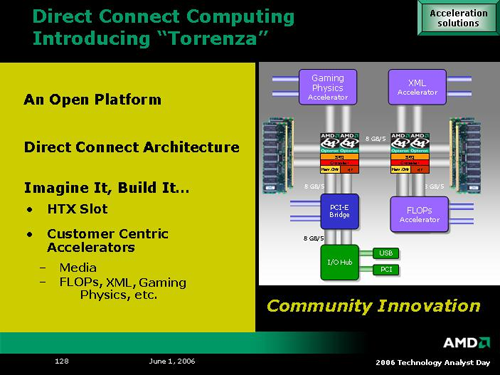
Update: Check out this image I snagged from an Inquirer article.

Thursday, May 18, 2006
Alright, it has been a while, and I'm not making an official posting (or revamp, for that matter) yet, but I have to say, finally. AMD chips can now be found in commercial Dell boxes! Albeit 4-processor servers exclusively, it is still a feat. Trying AMD products in one product line is more likely to lead to an expansion of their AMD-based systems in the future than naut, and this really demonstrates how far behind Intel has fallen with product catalog, aside from future designs. Speaking of which, the Pentium M design is finally spreading to desktop PCs, something I've been waiting for, although it would still be nice to see the ultimate x86 architecture design. If Intel and AMD would combine the best of both their architecture technologies, a highly scalable and advanced dual or quad-core 4-way superscalar processor with a large amount of cache would be amazing...maybe it's something that will arrive closer to realization with decreases in die size, as I do realize the memory controller in the AMD chip probably occupies a decent amount of die space that could be occupied by a larger cache and maybe a beefier core.
Anyways, here I go rambling again...the point of the matter in this specific posting is to point out how far AMD has gone...to demonstrate that even the most devotional company to Intel (aside from Apple, at the moment) had to cave due to a better performance and highly scalable x86 server CPU, the AMD Opteron, and to put the final nail in the coffin, one that solidifies AMD's stellar reputation in the chip industry.
Anyways, here I go rambling again...the point of the matter in this specific posting is to point out how far AMD has gone...to demonstrate that even the most devotional company to Intel (aside from Apple, at the moment) had to cave due to a better performance and highly scalable x86 server CPU, the AMD Opteron, and to put the final nail in the coffin, one that solidifies AMD's stellar reputation in the chip industry.
Tuesday, January 24, 2006
Speaking of Google, I might as well applaud the company for refusing to submit search result statistics to the government. I hope the trial pans out well for Google...and the rest of us. We don't need the government gaining another method of evading privacy, such as finding out who is performing what searches. Other than reading about it on the news, I was surprised to hear my Professional Expression professor mention it; he also mentioned students he's known wrongfully questioned for a library book request and an email to a friend in Italy after the incident there not too long ago. I'm glad that these issues are getting the limelight...hopefully we'll hear good things next month when the Patriot Act extensions that are set to expire actually do expire...or are at least revised. I want to be able to communicate with my relatives in Egypt and Jordan and borrow a book about communism without having to be questioned why, or worse.
Here's an interesting Slashdot headline concerning the Google executives and their salary. Supposedly this will be the second year they will only be pulling in $1 per year...pretty cool, huh? Well, I guess one could associate wise business decisions to that...more money stays within the company while they sell of stock, taking advantage of the $400+ stock price. And, thanks to Bush's tax cuts "to the wealthy" in 2002, income resulting from stock sales are taxed a lot less than income tax. Ultimately, though, although I don't approve of the way he said it, Tackhead makes a good point: it would be nice to see the government spend a lot less on the Pentagon. Anyways, I think the Google executives are only accepting $1 in salary as a statement for the company, more than anything.
BTW, I thought the food stamp remark was funny.
BTW, I thought the food stamp remark was funny.
Tuesday, November 29, 2005
$100,000 for a virtual space station?!?! But this was no joke, and Jon Jacobs thinks he can make over a million dollars in virtual taxes in 1 year! I guess it might be time to start investing in virtual equity now...Hiro Protagonist's (Snow Crash) knew what he was doing. Check out the Cnet article here.
Monday, November 28, 2005
300 GB of storage on a "Holographic Versatile Disc" (HVD)...hmm. Check out the Slashdot article here.
Wednesday, September 28, 2005
I know MIT's $100 prototype computer is old news, but now that CNET has photos available for the $100 laptop I thought I'd make a posting about it. I think it's funny that the photos advertise this laptop to function as a handheld, ebook, laptop, tablet pc, "theater", and writing pad; considering their optimism for this device, it's hard to believe the price tag will remain at $100, especially considering the form factor and the likely demand to arise from wealthy markets as well. Probably the coolest feature on the laptop is the hand-crank used to charge the battery, and funniest goes to the ac cord that also functions as a handle :)

Thursday, September 01, 2005
When I first moved into my new apartment one of the first things I noticed was an old Primestar dish sitting on the roof next to the porch. Primestar was bought out by DirectTV in 1999 and unfortunately no longer supports Primestar dishes (so it won't be possible to share my dad's DirectTV service) but I found a page that describes how to convert the dish into an 802.11b antenna. Although not terribly useful, if it can strengthen our wireless signal for the porch and our attic it might be cool. We'll see if I have the energy to try it out sometime...
Wednesday, August 31, 2005
Wednesday, August 24, 2005
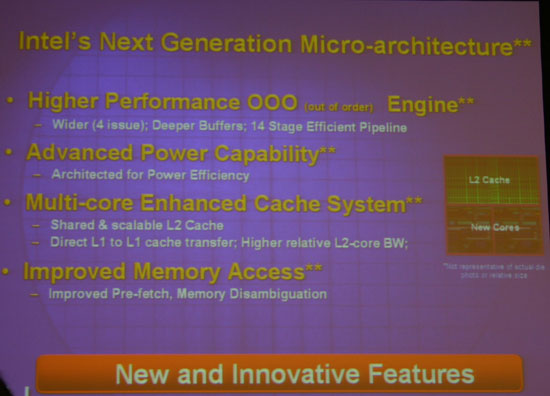
Intel is finally making some progress in the right direction for the desktop market by replacing the horribly inefficient Netburst architecture. The new architecture of currently no-name will consist of a 14 stage pipeline (2 more stages than the Athlon64 which will primarily provide Intel with more headroom for frequency) and a 4-issue core; in turn, this chip will be very competitive with the current Athlon64. More information can be found here.
A hard drive and dvd burner combo will soon be available from Hitachi supporting up to a Terabyte of data. Now I just need to convince Jesse to pick one up for Bascom (and maybe one for myself as well) :)
Subscribe to:
Posts (Atom)